
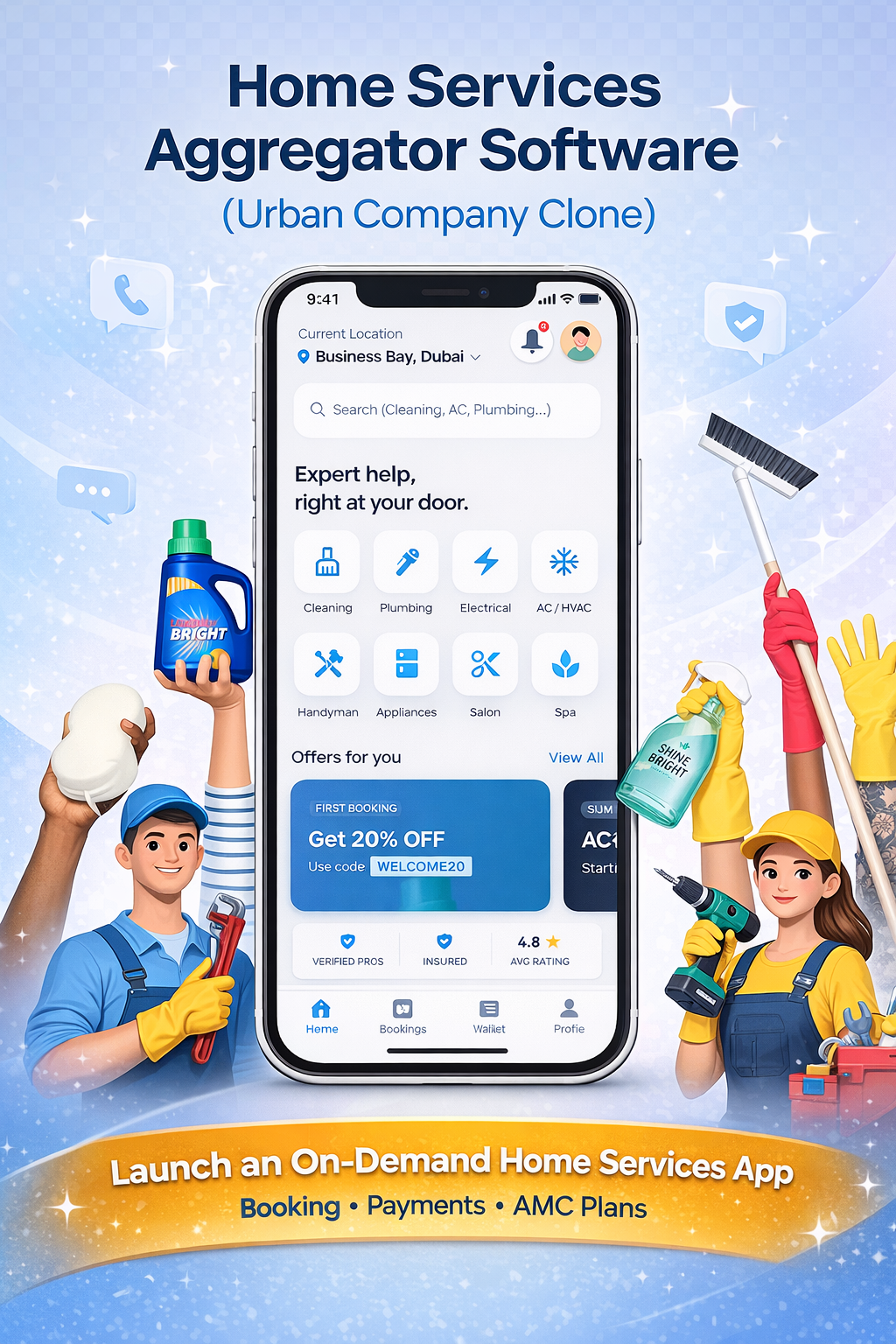
The on-demand home services market is expanding rapidly as users prefer booking verified professionals online. Platforms like Urban Company, Handy, and Thumbtack have proven that home services apps can scale quickly and generate consistent revenue.
However, these platforms also have limitations such as fixed pricing rules, restricted branding, and platform dependency. That’s why many startups and enterprises now choose to build their own home services app using custom software.
Fenizo specializes in building scalable Home Services Aggregator Software tailored for different business models.
Platform Overview
Urban Company
Urban Company operates as a managed services platform, controlling service quality, pricing, and training.
Key Strengths:
- Standardized service pricing
- Verified and trained professionals
- In-app booking & payments
- Strong quality assurance
This model is ideal for businesses aiming to build premium service marketplaces similar to Fenizo’s Local Services Marketplace Solutions.
Handy
Handy focuses mainly on cleaning and maintenance services, especially in the US and European markets.
Key Strengths:
- Subscription-based recurring services
- Background-checked professionals
- Fixed service pricing
- Simplified booking flow
Subscription-based service apps often integrate features used in Fenizo’s Service Booking Platforms.
Thumbtack
Thumbtack follows a lead-generation marketplace model, where service providers pay for customer leads.
Key Strengths:
- Pay-per-lead monetization
- Wide range of service categories
- Direct customer–professional communication
- Flexible pricing set by providers
This open marketplace approach is similar to Fenizo’s multi-vendor marketplace architecture, also used in platforms like 99acres Clone Real Estate Software.
Urban Company vs Handy vs Thumbtack – Comparison
| Feature | Urban Company | Handy | Thumbtack |
|---|---|---|---|
| Business Model | Managed services | Subscription services | Lead marketplace |
| Pricing Control | Platform-controlled | Fixed pricing | Provider-controlled |
| Monetization | Commission | Subscription | Pay-per-lead |
| Service Scope | Home & beauty | Cleaning & maintenance | All local services |
| Customization | Limited | Limited | Limited |
➡️ These limitations are why businesses prefer custom-built home services apps.
Why Build Your Own Home Services App?
Building your own app gives you complete ownership and flexibility, unlike third-party platforms.
Key Benefits:
- Full brand ownership
- Custom commission or subscription models
- Flexible pricing strategies
- Direct access to customer & provider data
- Scalable and secure architecture
Fenizo develops custom platforms similar to TaskRabbit Clone Software and on-demand service marketplaces.
Essential Features of a Home Services App
Customer App Features
- User registration & login
- Location-based service discovery
- Service booking & scheduling
- Secure online payments
- Real-time order tracking
- Ratings & reviews
- Push notifications
Service Provider App Features
- Provider onboarding & KYC
- Service & pricing management
- Booking accept/reject system
- Availability calendar
- Earnings dashboard
- Wallet & payouts
- Customer feedback
Admin Panel Features
- User & provider management
- Category & service control
- Commission & pricing settings
- Payment & payout management
- Dispute & support handling
- Reports & analytics
Admin workflows are similar to Fenizo’s enterprise systems like Crowdfunding Portal Software and scalable marketplaces.
Technology Stack to Build a Home Services App
Frontend
- Mobile Apps: Flutter / React Native
- Web Dashboard: React.js / Next.js
Backend
- Node.js (NestJS / Express)
- Laravel (optional)
Database
- MySQL / PostgreSQL
- MongoDB
Maps & Real-Time
- Google Maps / Mapbox
- Socket.IO / Firebase
Payments & Integrations
- Stripe / Razorpay / PayPal
- Wallet systems
- APIs via Third-Party Integrations
Cloud Hosting
- AWS / Google Cloud
Cost to Build a Home Services App
Development cost depends on features, regions, and scale.
Estimated Cost:
- Basic MVP: $3,500 – $6,000
- Mid-Level Platform: $6,000 – $12,000
- Enterprise Solution: $12,000 – $25,000+
You can review scalable pricing approaches on Fenizo’s MLM Software Pricing page.
Home Services App Models You Can Build
- Urban Company-like managed services app
- Handy-style subscription service app
- Thumbtack-style lead marketplace
- Hyperlocal service aggregator
- Multi-city & multi-vendor platforms
Conclusion
Urban Company, Handy, and Thumbtack succeed because they solve real-world home service problems. But building your own home services app gives you complete freedom to control pricing, branding, and growth.
If you’re planning to launch a custom home services marketplace, Fenizo offers end-to-end development with scalable architecture.
👉 Explore our Home Services Aggregator Software or TaskRabbit Clone to get started.