
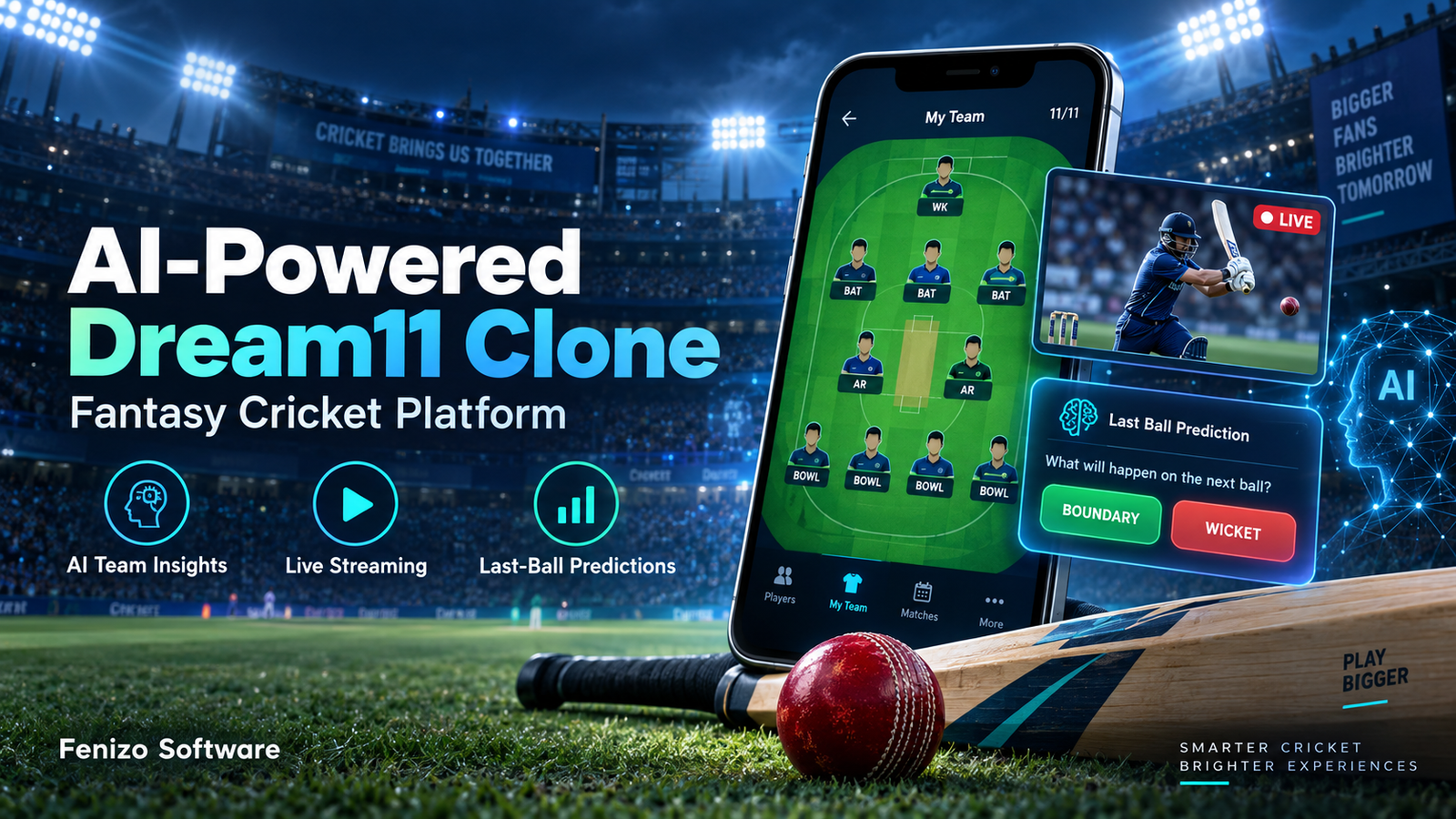
A Dream11 clone can evolve beyond team selection and leaderboard tracking into a complete match-day experience. AI-assisted research, live scores, video content, interactive predictions, and fan communities can give users more ways to participate before, during, and after a match.
For businesses that already operate fantasy sports software, the next step is to connect these features into one clear user journey. A fan should be able to research players, create a team, follow the match, join a prediction challenge, and review results without navigating through disconnected screens.
This guide explores proposed modules for upgrading an existing Dream11 clone with a modern fantasy cricket experience.
What Is an Advanced Dream11 Clone?
A Dream11 clone is independently developed fantasy sports software inspired by familiar workflows such as selecting players, joining contests, and earning points based on actual performances.
An advanced version can add AI analysis, video integration, live match interaction, and community features under your own brand.
The modules below are custom development options. They are not presented as features of the official Dream11 product or as an indication of affiliation.
1. AI-Assisted Fantasy Team Builder
An AI team assistant can help users compare players and create draft lineups using available match data.
Proposed features include:
- Recent-form and historical-performance summaries.
- Player comparisons by role.
- Venue and opponent analysis.
- Captain and vice-captain suggestions.
- Draft lineups that respect team composition and credit limits.
- Alerts when confirmed lineups become available.
- Explanations for each recommendation.
The assistant should distinguish confirmed information from estimates. For example, it should label a probable playing XI differently from an officially announced lineup.
AI recommendations should help users evaluate choices without promising winning teams or guaranteed prediction accuracy.
2. AI Match Insights and Cricket Assistant
A conversational assistant can make statistics easier to understand.
Users could ask questions such as:
- “Compare these two all-rounders.”
- “Which players have performed well at this venue?”
- “Why did my fantasy team receive these points?”
- “What changed after the playing XI announcement?”
Answers should use connected data sources, show when information was last updated, and acknowledge missing information.
Additional options include multilingual explanations, pre-match summaries, and post-match performance reviews. Numerical insights should come from a validated statistics system; the AI can then explain those results in plain language.
3. Live Match Centre and Ball-by-Ball Scores
A central match screen can connect fantasy activity with the live game.
The module can include:
- Live scorecards and commentary.
- Current batter and bowler details.
- Overs, wickets, partnerships, and run rates.
- Target and required run rate.
- Player-level fantasy points.
- Match status and interruption notices.
- Live contest standings.
- A recent-delivery timeline.
A licensed sports data feed should supply match events. The interface should display update status and handle scoring corrections, delayed feeds, and interrupted matches.
4. YouTube Live Streaming and Video Hub
YouTube integration can bring eligible live shows, creator commentary, interviews, and match analysis into the platform. YouTube’s official embedded player supports website playback and player controls through its IFrame API. YouTube IFrame Player API documentation.
Proposed video features include:
- Match-specific YouTube video placement.
- Scheduled pre-match analysis shows.
- Creator watch-along sessions.
- Post-match review playlists.
- Stream reminders.
- A match discussion panel beside the player.
- Admin controls for adding and removing video links.
Embedding a video does not provide broadcast rights. Full match footage requires the appropriate permissions, and videos must support embedding.
A useful alternative is original commentary alongside a licensed live score feed, with the experience clearly labelled as a watch-along.
5. Ball-by-Ball Prediction Module
A separate prediction module can let fans answer short questions during a match.
Examples include:
- Will the next legal delivery be a dot ball?
- Will a boundary occur in the next over?
- Will a wicket fall before the over ends?
- What run range will the batting side score in the next over?
A points-based mode can support leaderboards and friendly competition. These prediction points should remain separate from fantasy team scores.
Each question needs a defined opening time, server-controlled closing time, result source, and scoring rule. Real-money versions require a separate assessment of their operating model and target jurisdictions.
6. Last-Ball and Final-Over Challenges
Last-ball challenges can create a focused end-of-innings experience when the situation is known in advance.
Possible formats include:
- Runs from the next scheduled final delivery.
- Boundary or no boundary.
- Wicket or no wicket.
- Total runs during the final over.
- Whether a stated target will be reached by the end of the over.
Rules must clarify whether scoring refers to bat runs or total team runs. They should also explain how wides, no-balls, penalties, wickets, and extra deliveries are handled.
A challenge must define “last ball” precisely. For example, it may mean the sixth legal delivery of the scheduled final over. If the innings ends before that delivery, the published void rule should apply.
Predictions must close before the event occurs. A delayed YouTube stream cannot be used as the timing authority because some viewers may already know the result. Conservative deadlines and automatic suspension during feed problems help protect fairness.
7. Contest and Fantasy Team Management
The core fantasy experience remains an essential part of the upgrade.
Modules can cover:
- Public and private contests.
- Practice competitions.
- Configurable roster and credit rules.
- Captain and vice-captain multipliers.
- Team editing before the deadline.
- Contest invitations.
- Tie-breaking rules.
- Cancellation and abandonment handling.
- Transparent scoring breakdowns.
Any special substitution format needs its own published rules and deadlines. Team changes should never be silently permitted after a contest has locked.
8. Fan Communities and Creator Rooms
Community tools can give users a place to discuss matches and compare their analysis.
Proposed features include private fan groups, creator profiles, moderated discussions, polls, prediction leagues, and shareable team summaries.
Users should have blocking and reporting controls. Moderators need tools to handle spam, harassment, misleading claims, and suspicious promotional links.
Creator performance summaries should use verifiable records and clearly explain how results are calculated.
9. Personalized Alerts and Match Discovery
A personalized home screen can highlight followed teams, preferred tournaments, upcoming contests, and relevant video content.
Notification options can include:
- Confirmed lineup announcements.
- Team-selection deadlines.
- Match and stream start reminders.
- Prediction results.
- Contest settlement updates.
- Followed creator broadcasts.
Users should control notification categories and frequency. Clear preferences make alerts more useful and reduce unwanted interruptions.
10. User Dashboard, Points, and Transaction History
The account dashboard should provide a complete view of participation.
It can display fantasy teams, joined contests, prediction history, earned points, badges, subscriptions, and support requests.
If monetary features are part of an approved operating model, their balances and transaction records should be separate from practice points. Users should be able to understand pending entries, cancellations, refunds, and completed settlements.
Points should never appear withdrawable unless the published product rules actually allow redemption.
11. Advanced Administration Modules
An upgraded Dream11 clone needs operational controls that match its user-facing features.
| Admin module | Main functions |
|---|---|
| Match and tournament management | Fixtures, categories, match status, and provider mapping |
| Player management | Roles, credits, squad information, and lineup updates |
| Contest management | Entry rules, capacity, scoring versions, and cancellation policies |
| Prediction management | Question templates, deadlines, result review, and void rules |
| Video management | YouTube links, schedules, availability, and content permissions |
| AI management | Approved data sources, freshness checks, model versions, and feedback |
| Community moderation | Reports, blocked accounts, chat controls, and creator permissions |
| User support | Tickets, complaints, account history, and resolution records |
| Analytics | Active users, contest participation, prediction completion, and retention |
| Security and audit | Staff roles, sensitive-action logs, alerts, and access reviews |
Administrators should be able to investigate and correct errors without silently rewriting settled results. Corrections need a recorded reason and a clear user-facing explanation.
12. Reliability During High-Traffic Matches
Match starts, team deadlines, and final overs can create sharp traffic spikes.
The upgrade plan should cover concurrent submissions, duplicate requests, interrupted connections, and delayed data updates.
Important capabilities include server-controlled deadlines, dependable event processing, monitored real-time connections, and recovery procedures.
For prediction modules, fair timing and accurate settlement are more important than displaying an unrealistic promise of zero delay.
Business Models Beyond Contest Entry
An upgraded platform can explore premium analytics subscriptions, creator memberships, sponsorship placements, and software licensing.
A free-to-play experience can combine fantasy teams, non-cash prediction points, and fan engagement. Each monetization model should clearly explain what the user receives and keep sponsored content identifiable.
Financial projections should account for sports data licensing, video rights, AI usage, infrastructure, support, and moderation.
How to Upgrade an Existing Dream11 Clone
Start by reviewing the current application, data provider, scoring engine, and user journey.
A phased development plan can organize the work:
- Strengthen the core: Validate scoring, team deadlines, live updates, and administration.
- Add intelligence: Introduce player comparisons, AI explanations, and lineup alerts.
- Expand match-day engagement: Add eligible YouTube streams, watch-alongs, and community tools.
- Introduce predictions: Test points-based questions, last-ball rules, and settlement handling.
- Improve operations: Expand analytics, personalization, security monitoring, and performance capacity.
Each phase should have clear acceptance criteria before moving into production.
Frequently Asked Questions
Can AI features be added to an existing Dream11 clone?
Yes, subject to the application’s architecture and available data. The integration usually requires reliable statistics, backend changes, new interface screens, and a process for evaluating recommendation quality.
Can we show live cricket matches through YouTube?
Eligible YouTube videos can be embedded where playback is permitted. Showing full match broadcasts depends on content rights and availability. Creator commentary and watch-alongs are separate content formats.
Can fantasy contests and last-ball predictions work in one app?
Yes, as distinct modules with separate rules, scores, deadlines, and result histories. Users should always know which activity they are joining.
Can AI predict the exact last-ball result?
AI can estimate probabilities using available data, but it cannot guarantee the result of an individual delivery. Any estimates should be presented with appropriate uncertainty.
What affects the upgrade cost?
The main factors include existing code quality, sports data access, AI requirements, prediction logic, video integration, mobile applications, and expected traffic.
Discuss Your Fantasy Sports Upgrade with Fenizo Software
Want to expand your existing Dream11 clone with AI insights, YouTube integration, live match features, and interactive prediction modules?
Contact Fenizo Software to discuss your current application, preferred features, and target audience. A technical review can help define the integration requirements and a practical development roadmap.