

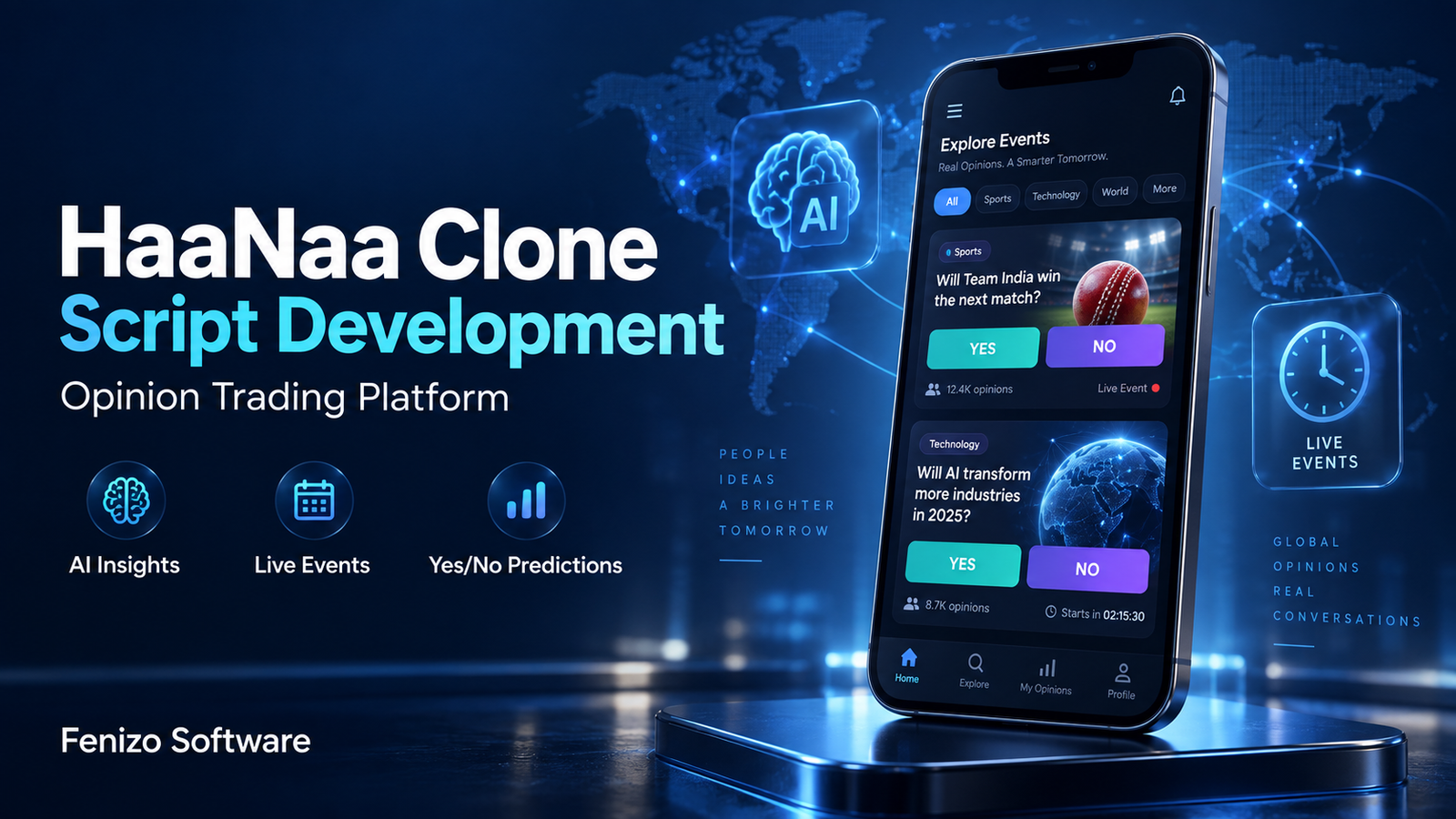
HaaNaa clone script development focuses on creating a branded platform where users explore events, evaluate possible outcomes, and participate in Yes/No prediction activities.
For businesses planning an opinion-based application, the opportunity lies in creating a clear, engaging experience supported by reliable event data and transparent rules. Users should understand what each question means, when participation closes, and how the final result will be determined.
A custom platform can combine event discovery, live updates, AI-assisted explanations, community features, and operational controls within one website or mobile application.
What Is a HaaNaa Clone Script?
A HaaNaa clone script is independently developed software inspired by the opinion-trading concept. It provides a foundation for building an application with comparable core workflows under your own brand.
Depending on the chosen model, users may participate through practice points, non-cash prediction challenges, or a separately assessed monetary trading system.
“Clone” describes the product concept. It does not imply access to HaaNaa’s proprietary source code, use of its branding, or an official partnership.
How Does an Opinion Trading Platform Work?
An opinion platform presents a question with clearly defined outcomes.
For example: “Will Team A win the scheduled match?” Users review the event information and choose their preferred outcome before the participation deadline.
A typical workflow includes:
- Event creation: An administrator defines the question, outcomes, deadline, and result source.
- Event discovery: Users browse categories and review relevant information.
- Participation: Users submit a prediction or place an order, depending on the platform model.
- Live updates: The application displays event progress and participation status.
- Resolution: The result is checked against the published criteria.
- Settlement: Points or positions are settled according to the rules.
In a trading model, closing a position before resolution depends on the execution mechanism and available liquidity. A simple prediction game does not require a trading engine.
Core Modules for HaaNaa Clone Script Development
1. Registration and User Profiles
The onboarding module can support email registration, mobile verification, secure sign-in, and account recovery.
Users can manage their profile, preferred categories, notification settings, and participation history. Additional verification workflows can be configured where required by the operating model.
2. Event Discovery and Categories
A well-organized event feed helps users find relevant questions quickly.
Proposed features include:
- Category filters and keyword search.
- Upcoming, live, closed, and resolved tabs.
- Followed topics and watchlists.
- Event deadlines and status indicators.
- Featured events selected by administrators.
- Personalized discovery based on user preferences.
Categories can include sports, entertainment, technology, and other suitable topics with objectively verifiable outcomes.
3. Yes/No Prediction Interface
Each event page should explain the question, possible outcomes, deadline, evidence source, and settlement rules.
Before confirming participation, users should see exactly what they are committing and how the outcome affects their points or position.
For a trading implementation, the confirmation screen should also show the price, quantity, applicable fees, and execution conditions.
4. Trading and Order Management
A monetary trading version requires an execution design appropriate to the product, such as an order book or a defined automated pricing mechanism.
Potential modules include:
- Order placement and cancellation.
- Open and completed order history.
- Partial-fill handling.
- Available and reserved balances.
- Liquidity visibility.
- Fee calculation and transaction records.
An instant-exit button should never imply that liquidity is guaranteed. The interface must explain when an order is pending or cannot be executed.
5. Live Event Updates
A live event module can display score changes, event milestones, closing notices, and resolution status.
For sports, a licensed data provider can supply structured match information. The system should identify delayed feeds and handle corrected results without silently changing user records.
Participation deadlines should be enforced by the server, rather than relying on a countdown displayed on the user’s device.
AI Features for an Advanced Opinion Platform
AI Event Summaries
An AI assistant can explain event background, summarize available statistics, and present relevant context in accessible language.
Summaries should identify their sources and show when the underlying information was updated. When reliable data is unavailable, the assistant should state that limitation.
AI Question Drafting
Administrators can use AI to draft event descriptions and identify ambiguous wording.
A review workflow can check whether the question has measurable outcomes, a reliable resolution source, and clear rules for cancellation or postponement. Human approval should remain part of publication.
Personalized Discovery
Recommendation tools can organize events around followed teams, selected topics, and language preferences.
Users should retain control over their feed. Recommendations should help them find relevant content without presenting participation as a guaranteed financial opportunity.
AI Support Assistant
A support assistant can answer questions about platform navigation, published rules, account settings, and transaction status.
Disputes, account restrictions, and settlement corrections should be escalated to authorized staff when needed.
Live Streaming and Community Modules
An optional video hub can bring eligible embedded YouTube content, creator commentary, and educational broadcasts into the event experience.
Useful features include scheduled shows, stream reminders, creator profiles, and moderated discussion rooms. Full event broadcasts require appropriate rights; embedding a video does not grant those rights.
Streaming and prediction timing must remain separate. Video delays vary between viewers, so a stream cannot serve as the authority for closing a prediction window.
Community features can include event comments, polls, private groups, reporting tools, and moderated discussions.
Sports and Last-Ball Prediction Options
A sports-focused version can support points-based challenges around match events.
Examples include:
- Whether a boundary will occur in a specified over.
- The run range for an upcoming over.
- Whether a wicket will fall before a stated deadline.
- The outcome of a defined final legal delivery.
Rules must explain wides, no-balls, abandoned matches, shortened innings, and events that never occur. Last-ball questions should specify the exact delivery rather than relying on an ambiguous label.
When reliable timing cannot be established, the platform should suspend the challenge instead of accepting potentially late predictions.
Wallet, Points, and Settlement Management
A points-based platform needs a ledger that records participation, rewards, adjustments, and completed results.
If monetary functionality is part of an approved scope, it requires separate balance, funding, withdrawal, reconciliation, and refund workflows.
Practice points and monetary balances should remain clearly distinguishable. Every settlement should be traceable to an event result and the applicable rule version.
Advanced Admin Panel Modules
| Module | Main capabilities |
|---|---|
| Event management | Questions, categories, deadlines, evidence sources, and publication |
| User management | Profiles, account status, verification workflows, and support history |
| Prediction controls | Participation limits, closing rules, suspension, and cancellation |
| Trading operations | Orders, execution status, liquidity monitoring, and fees |
| Result management | Evidence review, resolution, disputes, and recorded corrections |
| AI administration | Data sources, content approval, feedback, and usage monitoring |
| Content management | Banners, FAQs, notifications, video links, and educational content |
| Community moderation | Reports, spam controls, creator permissions, and blocked accounts |
| Analytics | Active users, event engagement, retention, and operational performance |
| Security | Staff permissions, audit logs, access reviews, and alerts |
Sensitive actions should be restricted to authorized staff and recorded for investigation.
Mobile Experience and Platform Reliability
A custom HaaNaa-inspired platform can support responsive web, Android, and iOS interfaces.
The experience should prioritize readable event cards, clear confirmation screens, accessible controls, and reliable reconnection after network interruptions.
The backend must handle concurrent requests, duplicate submissions, delayed provider updates, and settlement retries. These capabilities are essential when participation increases around popular events.
Planning the Business Model
Potential business models include premium analytics, creator subscriptions, sponsored educational content, and software licensing.
A real-money opinion-trading model requires separate jurisdiction-specific legal and commercial assessment before launch. Payment provider and app distribution requirements also need to be considered.
The product plan should distinguish free-to-play engagement from monetary participation at the beginning of development.
HaaNaa Clone Development Process
Development begins with defining the target audience, event categories, participation model, and resolution process.
The next steps are interface design, backend architecture, event and account modules, external integrations, and administration tools.
Testing should cover late submissions, cancelled events, unavailable data, disputed results, and interrupted transactions. A controlled pilot can validate the experience before a wider release.
Frequently Asked Questions
Can the platform use our own brand?
Yes. An independently developed platform can use your business name, visual identity, domain, and custom interface.
Can we start with a points-based version?
Yes. A points-based version can help validate event discovery, participation, leaderboards, and settlement before considering additional business models.
Can AI guarantee correct predictions?
No. AI can organize information and estimate probabilities, but it cannot guarantee event outcomes or profits.
Does a HaaNaa clone require blockchain?
No. Blockchain is optional. The architecture should follow the platform’s actual requirements for accounts, trading, transparency, and settlement.
How much does development cost?
The cost depends on the existing codebase, interface scope, trading mechanism, external data feeds, AI integration, mobile applications, and expected traffic.
Is this an official HaaNaa product?
No. This development concept refers to independently created software with its own branding and implementation.
Discuss Your Project with Fenizo Software
Planning an opinion trading or prediction platform? Contact Fenizo Software to discuss your preferred features, target audience, website and mobile requirements, and administration needs.
A defined scope can help turn the concept into a practical development roadmap with clear deliverables.